Looking for help and support with EBL Flash system

  • Please note, the forum recently had a problem with outbound emails for notifications, registrations, etc. A new email provider has been set up which should resolve all email issues. If you have any further trouble, please DM Christo or reach out via the Contact Us link in the website footer.
Did a little more tinkering with the truck this weekend, not much but I messed with the tach in the dash. found out that it's an OE replacement from LMC truck. it's electronic but doesn't have much of an adjustment. it has a tiny screw on the back just like the factory tach ,but it was already maxed out to read as accurate as it can.

after temporarily connecting a tach I had in the parts stash and verifying that the EBL was showing the correct RPM, we decided to remove the OE tach from the cluster. the other tach I have is a regular tach that is the size of the normal aftermarket temp or volt gauge, iirc 52mm diameter. I 3D printed some pieces I designed that would hold it in the same place that the factory tach went in the cluster without making any modifications to the cluster it's self. wired it in properly to the harness (which I also found out the harness is from Painless)

I don't really care for the look, but it will work for now until we can get different gauges that look proper, but it works as intended. with it being my son's truck and he will be the primary driver he will know the actual RPM and not push the engine too far.

Here are a couple photos. I think the tach that was in there was meant for a V8 engine, maybe in time if he wants to do a swap to a v8 then we can put that tach back in and it will be factory, unless it wants to do something like Dakota digital with the factory look.
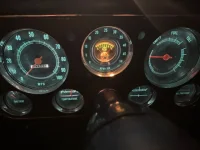
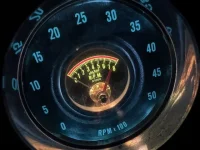
IMG_1191.webp
IMG_1192.webp
 
Next thing is to try and get the fuel gauge working. the truck sat up for a long time with bad gas in the tank, so I think that will be the first thing I look at is the sending unit. the truck has an aftermarket tank mounted where the spare tire would go between the frame rails behind the rear diff. I need to find out what tank it has and what sender is needed for the factory gauge too.
 
Well today I took my son out in the truck so he could start learning how to drive a stick shift we putted around for a while i an open parking lot, then ventured out to a store across town. left from the store headed home when problems began....

the truck seemed to start loosing power not wanting to accelerate. I took over driving and it started spitting and back firing out of the throttle body. still idling I pulled over and removed the air cleaner when it shut off. tried restarting but it would try to idle then die. when it died the tach started jumping around and I could hear something under the hood, turned off the key and then tried cranking once again. it fired up, stumbled around and shut off. this time I got out in enough time to see the injectors firing on their own when the engine had already shut off. the injectors didn't stop until I turned off the key!

we sat there for a bit, called momma to come rescue us LOL. waited till she arrived, I tried starting the engine once again, it fired up and idled, so we took off trying to get the truck home. made it about 4 blocks until we started loosing power again. same thing again, pedal to the floor and all I could get was 1st gear at about 10 mph. just as I was about to turn into the driveway it started with the spitting and back firing from the throttle body. got it in the driveway and shut it off.

it seems like something electronic is getting hot and breaking down. I almost want to put my finger on the ignition module inside the distributor, but not for sure.

This also might explain why when I was messing with the timing and VE learns it seemed to have great power on acceleration when the engine is cold, but as it warmed up seemed to loose it. now that it's warm outside up in the 90's and things heating up, they are starting to show their head.

what would be your thoughts on this? can a bad ignition module fire off the injectors with the engine not running as well as make it act like this?
 
This Company https://www.xfireperformance.com purchased Dynamic EFI's business and is planning on offering EBL products (and services?) - If you're thinking it's the EBL. Apart from that, all I can suggest is looking at all the temperature dependent tables and scalers in the EBL and see if there's any that look weird. You might have more luck on the 'third gen' board.
 
  • Like
Reactions: dbrannon79
I hope it isn’t the EBL. I feel like maybe the ignition module in the distributor. At least I’d rather fire the parts cannon at one of those first. If it’s not the problem we’d have a spare one if it’s ever needed.

Only thing is idk which one I need to get for it or what application I should use to get one from the auto parts store. The distributor is a GM HEI but without the vacuum advance since the EBL controls that. Do yall know what I need to ask for at the counter?
 
it fired up, stumbled around and shut off. this time I got out in enough time to see the injectors firing on their own when the engine had already shut off. the injectors didn't stop until I turned off the key!
The injectors should not fire unless the ECM (EBL) sees spark pulses. So there is either random spark pulses coming from the distributor...

Remind me again, is the distributor an HEI with or without spark control ( spark controlled does NOT have a vacuum advance). If it has a vacuum advance then it should have circuit to reduce the 12V pulses on the TACH output to 5 volt pulses. Or in another way, is there a wire from the TACH output of the coil to the ECM?
 
  • Like
Reactions: dbrannon79
With spark control no vacuum advance

I pulled the cap off to have a look. it has a factory GM 7 pin module in there (5 small pins on one end, two large on the other). button on the cap has some wear but not too bad. rotor and cap contacts are clean as well as the inside of the distributor. I was expecting to see more corrosion since it had been setting up for as long as the PO said. I'm sure all the grease under the module has dried up.
 
Last edited:
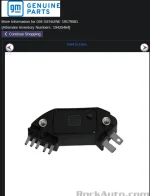
This is what I believe it to be from looking online. fits an 83 C10 pickup with a 4.1l 250 engine with CA emissions. Found this on Rockauto

View attachment 18071
Ignition modules have been known to become thermally intermittent, meaning the operate erratically when they get hot. Backfiring and lass of power is indicative of a faulty ignition module. Also since you state at one point the injectors were still firing when the engine had quit, that indicates that fuel was available.

Between the bottom of the module and the distributor case should be a coating of Heatsink Grease aka Thermal Compound. This facilitates the transfer of heat from the module to the distributor housing, it is not ordinary grease.

I would replace the module with a name brand one. Be sure to clean off the old thermal grease and apply new (There should be a small tube in the box with the new module). You don't want a thick layer of it, it just needs to fill any voids to get good heat transfer.

Here is an example of heatsink thermal grease:
 
  • Like
Reactions: dbrannon79
I have another one on order. no one had one in stock. Should be in tomorrow. hopefully it's the right one. I went off the application I found on RA. if it's correct, I plan to get another to keep in the truck as a spare.


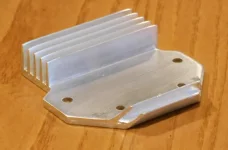
Just a curiosity. while I was trying to figure out which one I needed, I stumbled across a forum about them on a Chevy Nova forum talking about remote mounting them out of the distributor and away from heat. The were using a GM 10474610 aluminum heatsink. would this be a good idea? I would have to build a harness to do this and not tamper with any of the existing wiring or connections, but would be doable. any thoughts on this?

Here is a photo of that heatsink.
1774208404006.webp
 
Those modules were used by GM on many models for many years. I have never had a module fail, but I run my sparkplug gap at 0.040" rather than the early GM spec of 0.060 which they revised as it was causing failures.

Compared to the close quarters of the engine compartment in our motorhomes sitting on top of a 455CI engine running under much higher load, I think your under hood temperature will be much lower and the OEM setup should be just fine.
 
  • Like
Reactions: dbrannon79
Well were in a bit of a pickle. I found why this engine is so under powered. I decided to pull it into the back and check the compression along with other things which I should have done from the get go when my son bought it.

funny thing is the engine does not make any noises and was running perfictly fine, not missing or shaking at all. even when I fired it up today to move it from the front of the house to the back, it fired right up and ran smooth.

Ran the compression test and got 170 on cylinder 1, 2, and 3. 60 on #4, 0 on #5, and almost 70 on #6.

Oh shit....

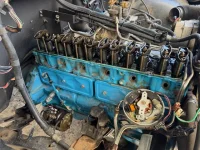
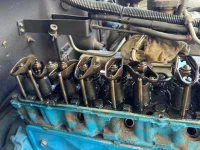
so I wanted to have a look at the cylinders but could not find my bore camera for the life of me. Pulled the valve cover and found three rocker arms off the push rods (back three cylinders) and all three are slightly bent. also found what looks like the studs for the rockers have pulled up from the head!!

IMG_1225.webpIMG_1226.webp
 
  • Wow
Reactions: RvRev2
I have a gut feeling that #4 has a bent valve too since it doesn't have any compression and there is an indentation mark on the ball end of the push rod. that stud is also up higher than the other two which are also pulled up some comparing them to the studs that are still in place.
 
I figured I would post an update on some findings. I cleaned up the studs on the #4 cylinder and found evidence that this has been like this for quite some time. this is why the engine really didn't have any power, but still ran smooth.

I made a call to the local machine shop and explained the situation (same machine shop that rebuilt this engine years ago) they recomended to have the head machined to use thread in studs. they quoted a ball park of $500-600 for a full rebuild of the head plus machine the studs for screw in. there is about a 3 week turn around. I will talk to my son and see if he agrees, but I think this will be the best route to take.

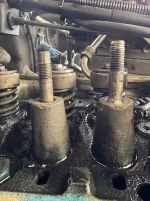
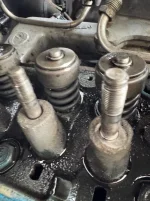
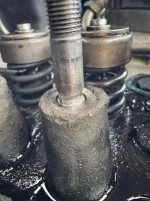
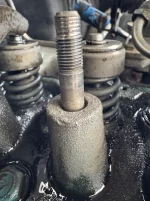
Here are more detailed photos of the #4 rocker studs. I pulled the rocker on both the intake and exhaust for #4 to get a closer look, the exhaust stud was perfectly fine but I noticed the threads are bad on it too, so I think all of the studs need to be replaced.

1774281859348.webp
1774281872159.webp
1774281884692.webp
1774281897296.webp
 
I figured I would post an update on some findings. I cleaned up the studs on the #4 cylinder and found evidence that this has been like this for quite some time. this is why the engine really didn't have any power, but still ran smooth.

I made a call to the local machine shop and explained the situation (same machine shop that rebuilt this engine years ago) they recomended to have the head machined to use thread in studs. they quoted a ball park of $500-600 for a full rebuild of the head plus machine the studs for screw in. there is about a 3 week turn around. I will talk to my son and see if he agrees, but I think this will be the best route to take.

Here are more detailed photos of the #4 rocker studs. I pulled the rocker on both the intake and exhaust for #4 to get a closer look, the exhaust stud was perfectly fine but I noticed the threads are bad on it too, so I think all of the studs need to be replaced.

View attachment 18088
View attachment 18089
View attachment 18090
View attachment 18091
That is wild! Who would have thought??
 
  • Like
Reactions: dbrannon79
I talked with my son about it and he's onboard with sending the head out to the machine shop. So now the plan is to pull the head by this coming weekend and get it to them. I'm also debating on pulling the engine to inspect it further. I guess that will depend on if a valve has kissed a piston or not. Although it might also make things easier to pull the head and all with the engine on a stand rather than breaking my back with it in the truck.
 
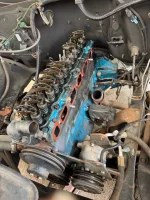
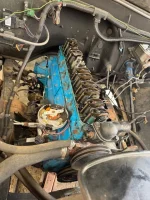
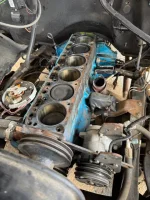
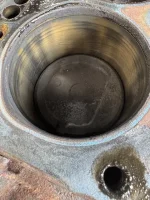
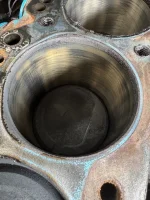
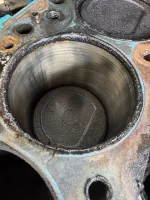
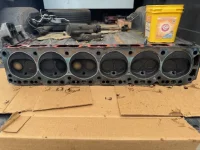
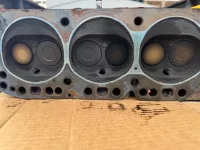
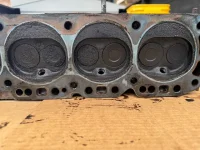
A little update on the truck... I pulled the head off today. there are no visible markings on any of the pistons that indicate a valve was kissed. all three of the rear cylinders are crudded up since they were not firing. I was really worried about #4 since it showed absolutely noting on the compression tester where #5 and 6 still showed 60/70 even with the rockers off the intake push rods. I saw on the #2 piston top that it's stamped .060" so it was bored to 60 over when it was rebuilt. all of the crosshatching still looks good. there are a few marks on the walls but I cannot feel them with my finger nails so that's a plus.

I still need to clean up the cylinders and gasket surfaces, but I can do that while the head is off at the machine shop. I did also notice that there is oil pooled up in the intake ports too, so it will need new valve seals at a minimum. hope the guides are still good, but we will see what the machine shop says.

Here are some tear down pics.

IMG_1249.webpIMG_1250.webp
IMG_1251.webp

Cylinder #1
IMG_1252.webp


Cylinder #3
IMG_1253.webp


Cylinder #4 had zero compression
IMG_1254.webp
IMG_1255.webp
IMG_1256.webp
IMG_1257.webp
 
Head is at the machine shop. the machinist inspected it while we were there and immediately told us what caused this. rotten gas! something I didn't see, he started scraping the inner walls of the intake port and said this is all old fuel and varnish that's coated the intake runner port. He said they will clean it all up and check everything over and let us know.