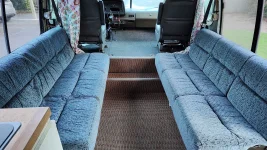
Getting ready to do the ceiling.
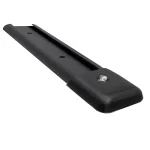
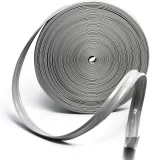
I decided to go with this retaining system rather than the H and J-channels I used for the walls (the same system used by Jim Bounds for his ceiling). The reason is that, if I ever need to get behind a ceiling panel, my way I just remove two rail and drop a panel vs. having to remove every panel installed ahead of the panel in question. And all of their retaining rails. Plus, I can put the panels in place now, then later (when the weather warms up) cover them with fabric and padding with minimal effort.
Purchased in bulk (x10), these rails are the same price as buying the H-channel from Home Depot. 92" each, cut as needed. Includes end-caps. No idea if I can use the caps, but I have them JIC.
Update:
(May 12 2024)
Installed the first retaining rail. Yes, I used the end-caps. Looks good!
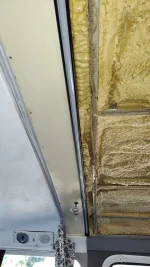
I'll place one every 4ft to minimize the number of ceiling panels to install. Only used 5 screws to match the curve of the ceiling. And yes, I'll paint the window trim grey to match the Panduit and rail cover at some point.
Update (June 9th 2024):
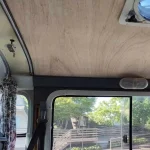
I'll be using the Panduit caps for the wire raceways between the walls and ceiling.
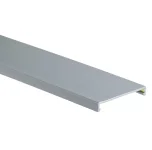
Found this:
Some have reported that it is too small and they could not get it to fit. My cable tray measures 3-3/16" with a caliper straight across the corners of the tray. Probably the same as what some have called a 3.25" tray. If you lay a tape measure across it the measure will bow a little and measure 3.25". The Panduit cover is 3-1/4" on the outside edges.
When I installed it on my GMC I found that I could hook the top of the cover over the top edge of the cable tray and then while pushing down on the top of the cover to bow the edge a little I could tap the bottom edge with a hammer and block of wood and get the cover to stretch a little so the bottom edge would bow out and snap onto the lower edge. It would probably help if you spray the area with some silicone spray before installing. With it installed the top and bottom of the cover are at a small angle to the face (i.e. greater than 90 degrees at the edge). But it looks great. It would probably be difficult to take it off once its installed but looks like it was made to go there. The original was about impossible to remove without breaking it off.
Emery Stora 77 Kingsley Frederick, CO
I'll have to try this as mine didn't fit.
I decided to go with this retaining system rather than the H and J-channels I used for the walls (the same system used by Jim Bounds for his ceiling). The reason is that, if I ever need to get behind a ceiling panel, my way I just remove two rail and drop a panel vs. having to remove every panel installed ahead of the panel in question. And all of their retaining rails. Plus, I can put the panels in place now, then later (when the weather warms up) cover them with fabric and padding with minimal effort.
Purchased in bulk (x10), these rails are the same price as buying the H-channel from Home Depot. 92" each, cut as needed. Includes end-caps. No idea if I can use the caps, but I have them JIC.
Update:
(May 12 2024)
Installed the first retaining rail. Yes, I used the end-caps. Looks good!
I'll place one every 4ft to minimize the number of ceiling panels to install. Only used 5 screws to match the curve of the ceiling. And yes, I'll paint the window trim grey to match the Panduit and rail cover at some point.
Update (June 9th 2024):
I'll be using the Panduit caps for the wire raceways between the walls and ceiling.
Found this:
Some have reported that it is too small and they could not get it to fit. My cable tray measures 3-3/16" with a caliper straight across the corners of the tray. Probably the same as what some have called a 3.25" tray. If you lay a tape measure across it the measure will bow a little and measure 3.25". The Panduit cover is 3-1/4" on the outside edges.
When I installed it on my GMC I found that I could hook the top of the cover over the top edge of the cable tray and then while pushing down on the top of the cover to bow the edge a little I could tap the bottom edge with a hammer and block of wood and get the cover to stretch a little so the bottom edge would bow out and snap onto the lower edge. It would probably help if you spray the area with some silicone spray before installing. With it installed the top and bottom of the cover are at a small angle to the face (i.e. greater than 90 degrees at the edge). But it looks great. It would probably be difficult to take it off once its installed but looks like it was made to go there. The original was about impossible to remove without breaking it off.
Emery Stora 77 Kingsley Frederick, CO
I'll have to try this as mine didn't fit.
Last edited: