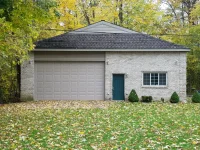
Concrete slab to park my GMC

1976GMC

Active member
Dec 16, 2017
264
47
28
Washington State
I'm getting ready to put up a carport to give our trusty old GMC a better protection from the elements. With that work in the near future, I want to first pour a concrete slab to have a good and more permanent spot to park it on. Does anyone know what opti.al thickness the slab should be to hold our MH weight? I would imagine a rebar reinforced pad is the way to go. I will talk to the concrete contractor when I get ready to do this, but I like to have as much pertinent info on hand before doing that. This way , I don't get sold a bunch of unnecessary fluff or headlight fluid :)
 
For just as parking pad, 4" would be just fine. Heck, it's even sufficient for most 2-post lifts if you read their install manuals. Those inflict way more concentrated stress than a set of tires.

Steel reinforcement is being abandoned in favor of glass fiber reinforcement. I had a 24x48 GFRC slab poured three years ago with no steel, and no cracks to date. As mentioned above, preparation is key. A good, compacted base pays off in the end.
 
If you are remotely considering putting an insulated building over this pad in the future, consider running in-floor heating tubing and insulation under the pad before you pour. If you live in a colder climate, there is nothing nicer than a heated floor to work on.
 
I'm getting ready to put up a carport to give our trusty old GMC a better protection from the elements. With that work in the near future, I want to first pour a concrete slab to have a good and more permanent spot to park it on. Does anyone know what opti.al thickness the slab should be to hold our MH weight? I would imagine a rebar reinforced pad is the way to go. I will talk to the concrete contractor when I get ready to do this, but I like to have as much pertinent info on hand before doing that. This way , I don't get sold a bunch of unnecessary fluff or headlight fluid :)
I recently poured a 12x28 by 4" thick, with thickened edge 6"x24" all around. Included 6x6 wire mesh and 3500lb concrete with fiber. Concrete guy said wire mesh was unecessary with the 3500lb and fiber.
 
What's under the concrete is equally important. Compacted soil graded to allow water to run away and a base of crushed stone equal or greater than the pad thickness. Start with good drainage.
 
If you are remotely considering putting an insulated building over this pad in the future, consider running in-floor heating tubing and insulation under the pad before you pour. If you live in a colder climate, there is nothing nicer than a heated floor to work on.
If putting a building over it in the future, he will most likely need to add a footing. Depth of footings vary by jurisidictions.
 

Attachments

  • 20191027_142721.webp
    20191027_142721.webp
    1.7 MB · Views: 4
IMHO, If money didn't matter, (6", 4000 PSI with Air Entrainment, #4 rebar 12" on center each way, PEX tubing for future heating needs (you only get one chance to put it in). Attach the tubing to the rebar to maintain spacing. Break it up into zones to even the heat out. If not you will get one cold side and one hot side.

From there Budget will dictate. Remember, concrete has a very high compressive strength, but not a high tensile strength. Therefore what Bill H. said is extremely important, Subgrade is very important. a subgrade of #57 stone consistently level. It's better to have a consistent 4" slab then a 6" slab that varies in thickness. Best to have a consistent 6" slab.

Cheap solar panels, Expansion Tank, Photo Cell and recirculating pump. Fill the system with antifreeze and don't worry about the system freezing. Almost free heat. Make sure you have air entrained concrete to handle freeze thaw.

These thoughts from over 20 years at Community Concrete Restoration and Community Concrete Material Supply LLC working with and manufacturing concrete, a Large Loss Claims Adjuster at Allstate Ins. and several years suing contractors for faulty and negligent work as a Subrogation Officer for Allstate Ins. Co.

Take care and best of luck.

Stay healthy,
Tom Katzenberger
 
  • Like
Reactions: tmsnyder
"I'm getting ready to put up a carport to give our trusty old GMC a better protection from the elements."

Or, dig two tire paths about 4" deep, lay and compress small gravel (rock fines), then lay pavers of your choice. If there comes a time that you want more, just pour the concrete and don't stop until the money runs out.
 
At the time I laid my hangar floor and several others that year we followed GMCer Tom Burke's recommendations for the floors and insulation. For most of his adult life, Tom was in the plumbing and heating and electrical business centered out of Whitehorse, YKT He did commercial and government contracts all over Yukon Territory for buildings like schools, airplane hangars, governments building like RCMP police stations, etc. The winter time temps reached -50 for a few weeks every winter and if anyof those clients had problems he had to fly in or drive in where possible to get them going again. He also was a piolot based out of Whitehorse.

His design point on concrete floors was to insulate the perimeter for 2 vertical feet all the way around with the blue foam sheeting used on basement and foundation walls. Then inside that 2" thick vertical form fill with dirt or sand, annd pack it thoroughly. Then place 4" thick foam horizontally using 4' by 8' sheeting for the first 4 feet in from the edges. Cover the next 4' in fron the edge with 2" sheeting. After that nothing. He said that the ground at that point was one big heat storage device. It works to your advantage not to insulate the cocrete slab ftom the earth. In floor liquid heatinng was usually used, but in large high ceiling buildings radiant heat was also a good solution.
 
  • Like
Reactions: tmsnyder
I recently poured a 12x28 by 4" thick, with thickened edge 6"x24" all around. Included 6x6 wire mesh and 3500lb concrete with fiber. Concrete guy said wire mesh was unecessary with the 3500lb and fiber.
This seem to be the most economical option. I was thinking that if 4" was not enough, to lay down 6" thickness where the tires would roll. I will read up more on the fiber reinforced concrete. I do t know if our local supplier provides that option. Thank you all for your input.
 
This seem to be the most economical option. I was thinking that if 4" was not enough, to lay down 6" thickness where the tires would roll. I will read up more on the fiber reinforced concrete. I do t know if our local supplier provides that option. Thank you all for your input.
Be sure to check with your local governmental agency, some require 4" concrete for sidewalks and 6" for driveways and parking areas.
 
  • Like
Reactions: 1976GMC