On your 403 vs. 455 mileage question I use to move one or two coaches a year for people. I never moved a 23' one but many 26' ones. When I moved them I was in no hurry and usually ran 60 to 65. I tracked fuel consumption and cost very closly because the owers were paying me actual expenses. I found on average on long distance trips the 403 averaged 1.3 mpg more. I made the identical trip on one 455 and one 403 between the Chicago area and southern California a year apart. The number came out the same 1.3 difference.
What motor has the best mileage?
- Thread starter vpearce
- Start date
You are using an out of date browser. It may not display this or other websites correctly.
You should upgrade or use an alternative browser.
You should upgrade or use an alternative browser.
On your 403 vs. 455 mileage question I use to move one or two coaches a year for people. I never moved a 23' one but many 26' ones. When I moved them I was in no hurry and usually ran 60 to 65. I tracked fuel consumption and cost very closly because the owers were paying me actual expenses. I found on average on long distance trips the 403 averaged 1.3 mpg more. I made the identical trip on one 455 and one 403 between the Chicago area and southern California a year apart. The number came out the same 1.3 difference.
Are there any data for the 454 swapped GMC motorhomes? What kind of mileage do they get?

Matt, would you explain in detail what you are referring to here…”high T bit”?Not just to pitch my own show, but I had data scatter out the bazoo until I did the High T bit. It was so simple and it only took a year and a 20K$us software package to figure that out. (The software was not actually pirated as I was in the employ of the license holder for a very short time.)
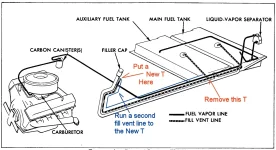
If you missed this, all you have to do is take the fill vent line T out of where it is near the T in the fill pipe, and move it to under the cab floor.
Matt
where exactly are you connecting and routing the fuel tank vent? Does this allow for mor precise fuel filling without the slow burping that happens during fill up? Any downside to this modification? Thanks
Ken Miller
Here is a image of what someone posted of the high tee setup from the photositeMatt, would you explain in detail what you are referring to here…”high T bit”?
where exactly are you connecting and routing the fuel tank vent? Does this allow for mor precise fuel filling without the slow burping that happens during fill up? Any downside to this modification? Thanks
Ken Miller
http://www.gmcmhphotos.com/photos/in-tank-fuel-pumps/p53352-20130719-141801.html


Kenny,
I also had great issues with getting stable fill levels because the fuel system was always regurgitating. As I has access to a software package that might help, I made a mathematical model of the entire fuel system and found out that all of my plans were junk. The fix is actually much more simple.
The fill vents are small lines that come off the top of both tanks and are T'd together near the fill pipe T. This is the problem. The rear - main - tank fills first because to the dynamics of the fill pipe. This forces fuel up the fill vent hose to the T. When the fill vent hoses are full of fuel, then the front - auxiliary - tank can't vent as it needs to fill and so the fill vent now chugs fuel up to the fill neck.
The simple fix is to separate the two fill vent hoses under the coach and run both as high up (most stop at just under the cockpit floor) and replace the T at that location. That is high enough st the pressure from the filling of the main tank can no longer stop the venting of the auxiliary tank.
In my case at least, this has been a highly successful mod. Fuel stops went from painful 45 minutes to 20 with time left over. Gas pumps run at ~10GPM (EPA Max) so it really shouldn't take more than 5 minute to fill a coach.
Matt_C
I also had great issues with getting stable fill levels because the fuel system was always regurgitating. As I has access to a software package that might help, I made a mathematical model of the entire fuel system and found out that all of my plans were junk. The fix is actually much more simple.
The fill vents are small lines that come off the top of both tanks and are T'd together near the fill pipe T. This is the problem. The rear - main - tank fills first because to the dynamics of the fill pipe. This forces fuel up the fill vent hose to the T. When the fill vent hoses are full of fuel, then the front - auxiliary - tank can't vent as it needs to fill and so the fill vent now chugs fuel up to the fill neck.
The simple fix is to separate the two fill vent hoses under the coach and run both as high up (most stop at just under the cockpit floor) and replace the T at that location. That is high enough st the pressure from the filling of the main tank can no longer stop the venting of the auxiliary tank.
In my case at least, this has been a highly successful mod. Fuel stops went from painful 45 minutes to 20 with time left over. Gas pumps run at ~10GPM (EPA Max) so it really shouldn't take more than 5 minute to fill a coach.
Matt_C
Matt, this is great information! I just drove back from Michigan, some 15+ hours with numerous stops to fill. Shortening. These will be a blessing! Thanks for taking the time to explain. I also had issues driving uphill with limited fuel in the tanks. Soon learned a need to keep the tanks near full. Not sure if others have experienced this.

On page 1 of this thread, Matt posted this diagram. Hope it helps.Matt, would you explain in detail what you are referring to here…”high T bit”?
where exactly are you connecting and routing the fuel tank vent? Does this allow for mor precise fuel filling without the slow burping that happens during fill up? Any downside to this modification? Thanks
Ken Miller
Thanks WallyHere is a image of what someone posted of the high tee setup from the photosite
http://www.gmcmhphotos.com/photos/in-tank-fuel-pumps/p53352-20130719-141801.html

You should do a little better then that, unless towing.With my '76 455 Birchaven, was pushing around 58 and got 7.3 MPG - damn! Have to drive slower. Are there any other motor options?
Thank you all for your info. So far, here in OR we haven't seen $5 per gallon yet!
But as far as mpg goes, you are money ahead buying gas then changing engines.

I have a 403 and drive pretty slow, 65’ish. I’m not in a hurry in the coach. I typically see around 11 mpg.

I just did a 700 mile trip. Numbers are a little suspect per the aforementioned fueling issues...
'78 26' 403, pretty much all stock (245/75r16 tires)
300 miles @ 50-55mph (not towing) 11 MPG.
Outbound trip I was following slower vehicles so throttled down....
250 miles towing my VW golf @ 55-65mph 9.9 MPG
Return trip I was on my own, and towing. I'd say my average was closer to 65 than 55.
'78 26' 403, pretty much all stock (245/75r16 tires)
300 miles @ 50-55mph (not towing) 11 MPG.
Outbound trip I was following slower vehicles so throttled down....
250 miles towing my VW golf @ 55-65mph 9.9 MPG
Return trip I was on my own, and towing. I'd say my average was closer to 65 than 55.
I just did a 700 mile trip. Numbers are a little suspect per the aforementioned fueling issues...
'78 26' 403, pretty much all stock (245/75r16 tires)
300 miles @ 50-55mph (not towing) 11 MPG.
Outbound trip I was following slower vehicles so throttled down....
250 miles towing my VW golf @ 55-65mph 9.9 MPG
Return trip I was on my own, and towing. I'd say my average was closer to 65 than 55.
Respectfully, 300 miles will give a rough estimate of mpg, but to get a really good number there needs to be multiple fill-ups, especially in these motorhomes b/c you could be filling it differently by gallons each time.
Here is every drop I've pumped into the GMC, notice the variability in the apparent mpg probably from the inconsistent fill-ups, variability in driving, who knows?
Attachments
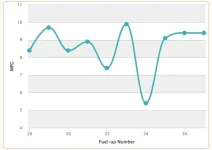
Yeah, thats why I made the disclaimer.Respectfully, 300 miles will give a rough estimate of mpg, but to get a really good number there needs to be multiple fill-ups, especially in these motorhomes b/c you could be filling it differently by gallons each time.
Here is every drop I've pumped into the GMC, notice the variability in the apparent mpg probably from the inconsistent fill-ups, variability in driving, who knows?
Just got home from a 2107 mile trip pulling a 2015 VW TDI Sportswagon. Ran through southern Colorado, Utah, Idaho with plenty of hills. 8300' pass was the highest we saw but plenty of 7000'+ running through out the trip. Used 153.287 gallons of diesel, 13.745 average mpg. Ran 62 -64 mph and only needed the a/c about 20% of the time. Nearing 40,000 on the swap and very happy with the results.Yeah, thats why I made the disclaimer.

You're new to this particular thread (no previous info.) and I don't see any sig... can you let us know what motor you're running to give your statement some context? Thanks! I'm always curious/excited to see real world numbers from people who've swapped out for diesel.Just got home from a 2107 mile trip pulling a 2015 VW TDI Sportswagon. Ran through southern Colorado, Utah, Idaho with plenty of hills. 8300' pass was the highest we saw but plenty of 7000'+ running through out the trip. Used 153.287 gallons of diesel, 13.745 average mpg. Ran 62 -64 mph and only needed the a/c about 20% of the time. Nearing 40,000 on the swap and very happy with the results.

It makes logical sense that the 403 would get somewhat better fuel economy than the 455, but there are a LOT of variables. The engine build, cam, carb jetting, FI or not, gearing, speed you drive, terrain, etc, can make a huge difference.
I installed an H1 6.5 TD and 4l80e transmission, used a B/W transfer case custom built for Revcon used in their later 454 chevy powered units. I ran a driveshaft forward to an independent front differential used on 2012 up one ton chevys. I used an intercooler from an early Dodge/Cummins pickup. I also built the wiring harness to keep the total electronics for the transmission, fuel injection, and cruise control. The effective final drive ratio is 2.80 so the engine runs about 1900 rpm at 62, hence the great fuel milage. With 500+ ft lbs or tq it has little trouble with hills. Overall a great combination.You're new to this particular thread (no previous info.) and I don't see any sig... can you let us know what motor you're running to give your statement some context? Thanks! I'm always curious/excited to see real world numbers from people who've swapped out for diesel.
Hal,
How did you make the floor and the frame cross members accommodate the new arrangement?
Matt_C
How did you make the floor and the frame cross members accommodate the new arrangement?
Matt_C
I ended up with a small step about 3" high and maybe 20" square behind the front step. It is similar to the step Avion ( I think?) put there. It is just below the toe kick of the front cabinet. I lifted the body 2.5" which enabled the engine hatch to remain flat. I built a new cross member to the rear which supports the trans and transfer case. The front cross member 'mostly' supports the engine and differential although is a bit more going on up there. The original forward cross member that runs over the trans was slightly modified to fit also. Raising the body enabled me to build an 8"+ tall single 75 + gallon fuel tank. I also re routed the fill line to outboard of the frame with 2" tube still filling from the same location. I'm able to fuel at truck stops with the large fill nozzles all be it at a reduced speed. I ended up using late Revcon torsion bars whichare 1 3/8" diameter and 4" shorter. The big issue with these bars is the flats aren't parrallel like the GMC's which required modifying the control arms. Fun rewarding project for sure.Hal,
How did you make the floor and the frame cross members accommodate the new arrangement?
Matt_C