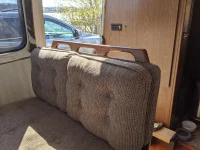
Here’s a functional and attractive project I just finished. I'll confess that I first saw a teak handrail like this on a fellow Nor'easter's coach, so it's not an original idea. I think they should have come from the factory this way, though, because the handrail helps with ingress and egress and helps keep the upholstery clean. There are some tricky bits involved so I've included lots of detail. Enjoy!
First, a photo of the finished project:
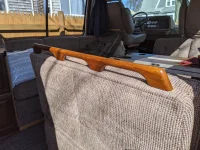
Here's the step-by-step: Get a 33" teak three-loop handrail. Drill holes as shown. There are four 1/2" holes on top drilled 7/8" deep using a Forstner bit in order to make a clean, flat-bottomed hole for the plugs and landings for the bolts. I chose this depth for strength so that the landings would not be below the height of the handrail loops. There is also a 1/2" hole drilled 1/8" deep on the bottom to provide clearance for the rivet nuts we'll be installing in the seat frame. The through hole is 1/4" so that there's a bit of slop for #10 bolts. If you don't have a drill press (highly recommended), drill the through hole up from the bottom after drilling the top and bottom 1/2" holes. This way, the bottom hole will be exactly where you want it and any inaccuracy in your drilling will only show up at the landings for the bolts inside the handrail.
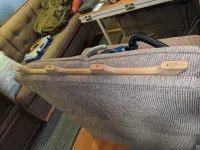
Run a length of 3/4" light-colored electrical tape along the seatback, aligning it by feel with the metal frame under the upholstery fabric. Carefully measure and mark the locations corresponding to the holes in the handrail, and (deep breath) slice open the upholstery where marked. I made cross-type slices about 1-1/4" wide and 1/2" fore/aft. You only need to remove enough fabric for the bolt to clear, but the slices need to be larger so there's room to work.
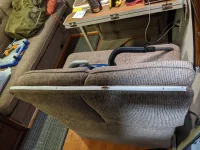
When you expose the metal seatback frame through the four sliced areas in the upholstery, you'll see that the square frame channel is folded over itself on top. Mark and center-punch the hole locations in the metal, being sure to find the center (fore-aft) of the upper folded-over metal flap. This avoids a potential problem with your holes being too close to the edge of the upper flap. Drill 1/8" pilot holes to avoid any creep in the location of the larger holes, then drill 19/64" holes (bits available from Amazon) for the rivet nuts.
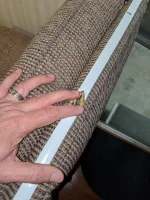
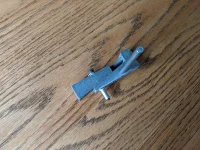
Install the four 10-32 steel rivet nuts. If you decide to use the tool pictured (I like it because it avoids problems with the rivet nuts wanting to spin), be careful not to break it by overtightening the bolt when compressing the rivet nut. When you feel the resistance increase, you're done.
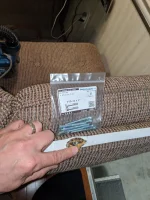
After sanding the handrail smooth with 220 grit sandpaper, cover the seatback with thin plastic drop cloth and attach the handrail to the seatback using 2" 10-32 socket cap bolts, flat washers, and blue Loctite. Apply carpenter's wood glue to 1/2" teak plugs and tap them into the holes, carefully wiping off any excess glue with a moist rag. Wait a day for the glue to dry, then shave the plugs flush using a wood chisel and sand until perfectly smooth.
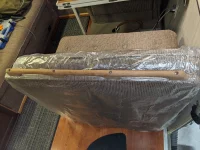
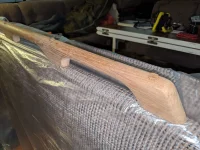
Wipe down the raw teak with Acetone to prep the surface, then apply a coat of Cetol Door & Window clear satin wood finish. Apply two more coats, waiting a day between each coat. It's not necessary to sand between coats but it's okay to smooth out any bumps. After the final coat has dried for a day, lightly slice around the bases of the handrail posts with a razor blade so that you can remove the plastic without damaging the upholstery or the wood finish.
For those of you who don't have a drill press or the inclination to machine the handrail, I'm considering putting together a kit consisting of a pre-drilled handrail, rivet nuts, bolts, washers, and teak plugs. PM me if interested.
First, a photo of the finished project:
Here's the step-by-step: Get a 33" teak three-loop handrail. Drill holes as shown. There are four 1/2" holes on top drilled 7/8" deep using a Forstner bit in order to make a clean, flat-bottomed hole for the plugs and landings for the bolts. I chose this depth for strength so that the landings would not be below the height of the handrail loops. There is also a 1/2" hole drilled 1/8" deep on the bottom to provide clearance for the rivet nuts we'll be installing in the seat frame. The through hole is 1/4" so that there's a bit of slop for #10 bolts. If you don't have a drill press (highly recommended), drill the through hole up from the bottom after drilling the top and bottom 1/2" holes. This way, the bottom hole will be exactly where you want it and any inaccuracy in your drilling will only show up at the landings for the bolts inside the handrail.
Run a length of 3/4" light-colored electrical tape along the seatback, aligning it by feel with the metal frame under the upholstery fabric. Carefully measure and mark the locations corresponding to the holes in the handrail, and (deep breath) slice open the upholstery where marked. I made cross-type slices about 1-1/4" wide and 1/2" fore/aft. You only need to remove enough fabric for the bolt to clear, but the slices need to be larger so there's room to work.
When you expose the metal seatback frame through the four sliced areas in the upholstery, you'll see that the square frame channel is folded over itself on top. Mark and center-punch the hole locations in the metal, being sure to find the center (fore-aft) of the upper folded-over metal flap. This avoids a potential problem with your holes being too close to the edge of the upper flap. Drill 1/8" pilot holes to avoid any creep in the location of the larger holes, then drill 19/64" holes (bits available from Amazon) for the rivet nuts.
Install the four 10-32 steel rivet nuts. If you decide to use the tool pictured (I like it because it avoids problems with the rivet nuts wanting to spin), be careful not to break it by overtightening the bolt when compressing the rivet nut. When you feel the resistance increase, you're done.
After sanding the handrail smooth with 220 grit sandpaper, cover the seatback with thin plastic drop cloth and attach the handrail to the seatback using 2" 10-32 socket cap bolts, flat washers, and blue Loctite. Apply carpenter's wood glue to 1/2" teak plugs and tap them into the holes, carefully wiping off any excess glue with a moist rag. Wait a day for the glue to dry, then shave the plugs flush using a wood chisel and sand until perfectly smooth.
Wipe down the raw teak with Acetone to prep the surface, then apply a coat of Cetol Door & Window clear satin wood finish. Apply two more coats, waiting a day between each coat. It's not necessary to sand between coats but it's okay to smooth out any bumps. After the final coat has dried for a day, lightly slice around the bases of the handrail posts with a razor blade so that you can remove the plastic without damaging the upholstery or the wood finish.
For those of you who don't have a drill press or the inclination to machine the handrail, I'm considering putting together a kit consisting of a pre-drilled handrail, rivet nuts, bolts, washers, and teak plugs. PM me if interested.