So what did you do to your GMC today?

  • Please note, the forum recently had a problem with outbound emails for notifications, registrations, etc. A new email provider has been set up which should resolve all email issues. If you have any further trouble, please DM Christo or reach out via the Contact Us link in the website footer.
Entrance porch-light upgrade:

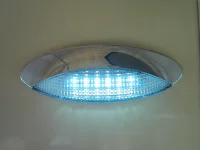
I swapped out the original porch light with this new fangled LED all-weather modern war-of-the-worlds eye chrome unit.
DSCF0023.webp
You can see my entrance handle lit up in blue as well

Space-age design
DSCF0024.webp
I reposition the new light wire from the right of the mount over to the center of the plastic bezel so the unit would fit in the same space and use the same hole.

Covers the old original light space real nice.
 
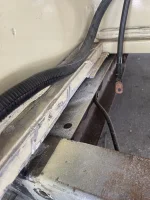
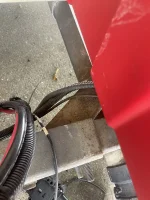
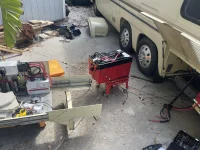
View attachment 16867I am trying to prevent this from happening. There were only (4) bolts holding it into place and they were so close together vertically that they could not resist this moment. I could not determine the solution until I disassembled it.
View attachment 16869
It was only attached to the grey steel chassis by these (4) bolts. That was certainly not enough to resist the rotation that would cause the type of failure above.
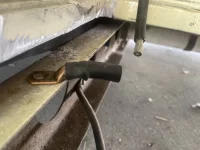
View attachment 16870
The puck in the ellipse is separating the yellow aluminum and fiberglass components from the gray steel chassis frame members.
If I remove the rest of the aluminum flange in the rectangle, (like it was further to the left), I will gain access to the chassis to bolt the slide to. It will also eliminate the binding issues I had in removing the slide.
If I add (2 )vertical bolts with washers I will adequately support the slide and eliminate the rotational problem.
This is a simple and safe solution that should have been utilized in the first time.

I hope that this will soon be accomplished so that I can get back to activsating the 51.2vdc system.

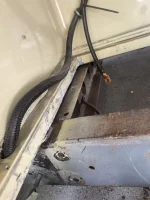
IMG_3207.webpThat Aluminum member is partially removed here using an oscillating saw. but......

IMG_3208.webp
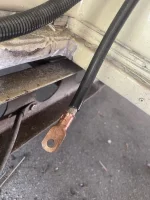
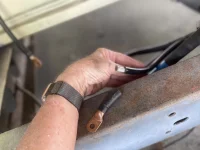
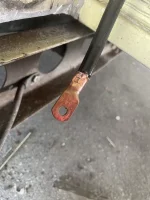
after i checked that battery cable, it fully rotated and was being held in place by the shrink tube. You can see that there is no crushing of the stranded tined wire, so this is a terrible connection.
IMG_3212.webp
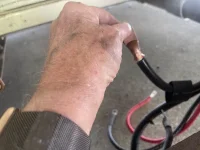
While the lug looks as though it had been crimped it was only cursory and had zero mechanical strength and dubious electrical capability. IMG_3215.webp
There was the same problem with the second lug I checked.
IMG_3218.webp
and the third.
I will have to check every lug in the coach now. It may be the source of intermittent problems or mysterious future issues.
I paid good money for this work but .........

IMG_3221.webp
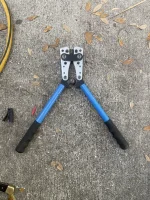
This is the heavy duty crimping tool for battery sized cables. It is notes to use. It requires a lot of force. Sometimes, I have to tuen it sideways with one arm on the ground and the other one sticking up. I then have to step on the upright one to apply sufficient t force to crimp the lug to a battery cable.
IMG_3219.webp
Trimming the aluminum member likely eliminated the binding of the custom slide. It took me four days to pull it slide out with a lot of cursing.
A pre-existing hole in the chassis cross member was not used to eliminate the rotation of the battery slide. I plan to use a new bolt here and drill a second hole further back.
IMG_3220.webp
There is another diagonal chassis member on the right side. I plan to drill another hole here as well.
The battery slide will then be properly installed structurally as it should have been done in the first place.

I am beginning to think that I cannot trust anyone but me to work on my coach but sometimes I am not so sure about me.

Will I have to reinspect all of the work that was done by others when my coach was not next to my house?

How about the ones that were done by previous owners.

You should check all of your battery cables and try to rotate the lug. If it moves, even a little bit, you need to crimp it again or replace the lug.
 

Attachments

  • IMG_3211.webp
    IMG_3211.webp
    952.3 KB · Views: 4
After accumulating several parts for the GMC, I decided to clean out my storage shed full of parts. With my pick-up box loaded with windows, 455 engine brackets, Onan parts, wire harness, cv joints and boots (inner and outer), 2 intake manifolds, three heads, inner and outer wheel caps, lug nuts, cabinet hinges, engine block dip stick holder, longe transmission dipstick tubing, 2 sets of torsion bars, gauges, and several misc. parts I took them to a mechanic in Colorado that works on GMC's in his spare time.
I had been planning this for 6mo. to get rid of a lot of my personal junk so the wife won't have to when I am no longer around. I have seen this too many times when the husband is gone and now the wife has to deal with what to do with all of the junk the hubbies have accumulated.
 
View attachment 16894That Aluminum member is partially removed here using an oscillating saw. but......

View attachment 16895
after i checked that battery cable, it fully rotated and was being held in place by the shrink tube. You can see that there is no crushing of the stranded tined wire, so this is a terrible connection.
View attachment 16897
While the lug looks as though it had been crimped it was only cursory and had zero mechanical strength and dubious electrical capability. View attachment 16898
There was the same problem with the second lug I checked.
View attachment 16899
and the third.
I will have to check every lug in the coach now. It may be the source of intermittent problems or mysterious future issues.
I paid good money for this work but .........

View attachment 16902
This is the heavy duty crimping tool for battery sized cables. It is notes to use. It requires a lot of force. Sometimes, I have to tuen it sideways with one arm on the ground and the other one sticking up. I then have to step on the upright one to apply sufficient t force to crimp the lug to a battery cable.
View attachment 16900
Trimming the aluminum member likely eliminated the binding of the custom slide. It took me four days to pull it slide out with a lot of cursing.
A pre-existing hole in the chassis cross member was not used to eliminate the rotation of the battery slide. I plan to use a new bolt here and drill a second hole further back.
View attachment 16901
There is another diagonal chassis member on the right side. I plan to drill another hole here as well.
The battery slide will then be properly installed structurally as it should have been done in the first place.

I am beginning to think that I cannot trust anyone but me to work on my coach but sometimes I am not so sure about me.

Will I have to reinspect all of the work that was done by others when my coach was not next to my house?

How about the ones that were done by previous owners.

You should check all of your battery cables and try to rotate the lug. If it moves, even a little bit, you need to crimp it again or replace the lug.
That's a shame, I wonder if those were actually the correct lugs for that wire? They look a little big to me.

For crimping, I've really been enjoying the hydraulic ones. They're cheap and prolific these days, and work great. Normally the sizes are in mm^2, or completely made up AWG sizings, but if you figure out which one to use they work great. Much easier to use than the long-handled mechanical ones, and you can get some serious crimping force. I've even used them to press rusty exhaust studs out of flanges in a tight space.

 
  • Like
Reactions: dsmithy and Wally
View attachment 16894That Aluminum member is partially removed here using an oscillating saw. but......

View attachment 16895
after i checked that battery cable, it fully rotated and was being held in place by the shrink tube. You can see that there is no crushing of the stranded tined wire, so this is a terrible connection.
View attachment 16897
While the lug looks as though it had been crimped it was only cursory and had zero mechanical strength and dubious electrical capability. View attachment 16898
There was the same problem with the second lug I checked.
View attachment 16899
and the third.
I will have to check every lug in the coach now. It may be the source of intermittent problems or mysterious future issues.
I paid good money for this work but .........

View attachment 16902
This is the heavy duty crimping tool for battery sized cables. It is notes to use. It requires a lot of force. Sometimes, I have to tuen it sideways with one arm on the ground and the other one sticking up. I then have to step on the upright one to apply sufficient t force to crimp the lug to a battery cable.
View attachment 16900
Trimming the aluminum member likely eliminated the binding of the custom slide. It took me four days to pull it slide out with a lot of cursing.
A pre-existing hole in the chassis cross member was not used to eliminate the rotation of the battery slide. I plan to use a new bolt here and drill a second hole further back.
View attachment 16901
There is another diagonal chassis member on the right side. I plan to drill another hole here as well.
The battery slide will then be properly installed structurally as it should have been done in the first place.

I am beginning to think that I cannot trust anyone but me to work on my coach but sometimes I am not so sure about me.

Will I have to reinspect all of the work that was done by others when my coach was not next to my house?

How about the ones that were done by previous owners.

You should check all of your battery cables and try to rotate the lug. If it moves, even a little bit, you need to crimp it again or replace the lug.
IMG_3228.webp
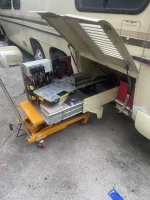
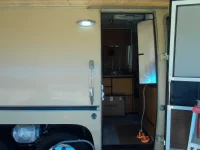
One battery is secured and the battery slide is going back in.
 
  • Like
Reactions: RvRev2
Rains have started in PNW but during a 2 day dry spell this week applied eternabond to windshield/roof joint. Was a bit of a pain as coach is fitted with a brow but managed to get it done before the big rain.
Checked today, annoying drip at steering wheel gone!
 
  • Like
Reactions: pvfjr
While installing the Toyota headlights I noticed my fusible link wire had separated from the insulation. Replaced with spare fusible link I had. View attachment 17013
Umm, how can that happen? I thought the overcurrent was designed to fry the wire and the insulation would stay intact. I've read of people pulling on the fusible link and when it stretched or came apart they knew it was toast.
 
Umm, how can that happen? I thought the overcurrent was designed to fry the wire and the insulation would stay intact. I've read of people pulling on the fusible link and when it stretched or came apart they knew it was toast.
Have you checked out the large cable across the front running to the rear battery? The insulation was absolutely toast on mine ,cracking apart. I think that area just get abused by light and heat and after 50 years the insulation gives up.
 
Heavy frosts have started to be normal in upstate NY, so Gonzo is tucked away for the winter. Tanks dumped, lines blown out using its own air compressor, hot water tank bypassed, pink antifreeze pumped out all fixtures, all paper removed and many mouse traps set inside, and a "walk the plank" resetting bucket trap placed outside the coach.

With my brother's help, we also jacked up into its final resting place my 1975 Glenbrook parts coach. I plan to remove the knuckles and ship to Dave Lenzi for complete rehab and zerks. And pull the outer CV joints to carry as a backup just in case. One for me, one for my brother's Palm Beach.

We placed the Glenbrook at the edge of a field, not the greatest spot but we might be able to shoot a deer using the coach as a blind lol

1000003197.webp
 
Last edited:
Not sure where on the coach this is located? Don't think my Palm Beach has such a thing?
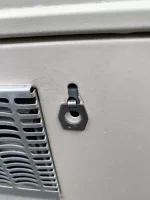
Access door is from a gas water heater installed by Coachman. (Royal)
Have you checked out the large cable across the front running to the rear battery? The insulation was absolutely toast on mine ,cracking apart. I think that area just get abused by light and heat and after 50 years the insulation gives up.
Cable is ok on my 77 but I had to replace a section of cable up front on the 76.
 
  • Like
Reactions: boybach
Final fitting on the new seat bases before last welding and installation. There will be three #8 bolts just in the seat-belt anchor material at the edge of the top step (behind the seats). Plus re-using the original mounting holes for the OEM seat bases.

Also installed the steering column drop spacers to get the steering wheel to a more comfortable position. I hope to have the "new" seats finished by the weekend.

I have read complaints that the Gen 5 (2018-2022) Odyssey 2nd row seat arm-rests are too thin/short for proper support. They are! But, the arm-rests from the Gen 4 seats (in the coach when I purchased it) are interchangeable.... 😁

While the installation is about an inch lower than my original seating, it lines-up better with the toll window; I can now get my shoulder out that window to enter access code into short pedestal keypads at the storage facility where I keep the coach. Until now, I've had to park, jump out, enter the code, then run back and drive before the gate closes.

I'll post pics of the completed base and the installed seats when everything is finished. Kelvin has CAD drawings and parts list, if anyone wants to duplicate the installation. I've suggested he offer an assembled kit with two bases. Just bolt them in and locate seats from a salvage yard. As the seats simply drop/click in place, installation is a snap!

1762192813261.webp
 
  • Like
Reactions: pvfjr
View attachment 17006
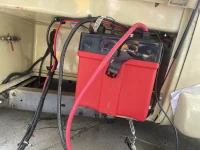
One battery is secured and the battery slide is going back in.
IMG_3248.webp
I had to pull the slide out again and the installed battery to gain access to the IonBus inlet.
IMG_3244.webp
The cables that were provided to me were straight through and there was insufficient clearance to install them. After much searching I was able to find this right angle M12 8 pin cable with the 90° connectors at both ends. I have connected all of the cables and now still have only about 1" of clearance.
The tan masking tape has a marked arrow to orient the connector. I can't see the top.
IMG_3246.webp


IMG_3255.webpThe battery is now secured and the slide is back in.
IMG_3257.webp
The original installation was secured by only these 4 bolts but that was insufficient to prevent the slide from drooping down when the slide was pulled out. I did replace the bolts with stainless steel ones though.
IMG_3256.webp
There were 4 pairs of bolt holes on each rail already bored on the slide but were not used. I have already started to drill out 3/8" holes int eh chassis members below to install 4 more vertical stainless steel bolts to prevent the slide from drooping.
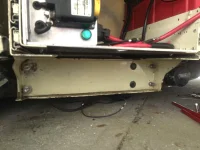
It is torturous boring these new holes in the chassis, getting these 4 bolts in place and I had to give up after placing just one of the four. I have not yet tighten that bolt yet.
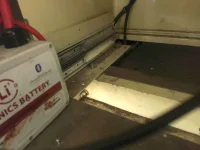
This has me wishing for a lift for the coach so I wouldn't have to lie down on the slide.
IMG_3258.webp
The battery is also now more securely tied down.
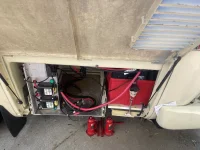
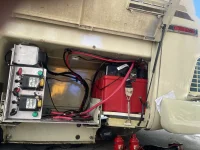
On the left those two electrical devices with the yellow knobs are actually battery switches unlike the ones you are used to seeing. The Underwriter Laboratories requires battery switches on both the negative and positive battery cables to comply with their requirements. Usually only a single battery switch on the red cable is installed.
These switches are actually solenoid switches and can be turned on and off by rotating the yellow knob or remotely.
When the battery bank is operational, the 2 large green led signal light will be on.
IMG_3252.webp
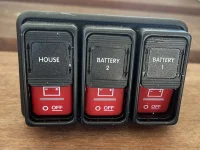
These are the 3 remote switches that I will be installing in the dashboard. The 2 switches on the right will control the 51.2vdc battery switches and the one on the left will control the 12vdc battery bank.
 
Unfortunately, it was time to winterize the GMC. This time I installed a winterizing kit at the potable water pump, and I also installed a water heater bypass kit. Really saved a lot of RV antifreeze compared to last year.
 
  • Like
Reactions: tmsnyder
It is torturous boring these new holes in the chassis, getting these 4 bolts in place and I had to give up after placing just one of the four. I have not yet tighten that bolt yet.
This has me wishing for a lift for the coach so I wouldn't have to lie down on the slide.
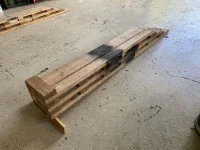
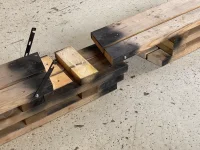
Wooden drive up ramps are a big help, and without a doubt the easiest way to work on the underside if you don't have a pit or a lift.

They're heavy and awkward so I modified the ramps the PO had made by cutting them into interlocking halves so they'd be easier to handle and store.
1762257976085.webp
1762258033606.webp
1762257937400.webp